


History of Unani
The Unani system of medicine owes, its origin to Greece. The term ‘UNANI’ is derived from the word ‘UNAN’ or ‘Ionian’ which means Greece in Arabic ‘YAVANAS ‘in sanskrit. It was the work of the Greek philosopher-physician Hippocrates {Buqrat In Arabic} (460-377 B.C.), who freed medicine from the realm of superstition and magic and established it as a science. He considered illness to be natural rather phenomenon and felt that medicine should be administered without ritual ceremonies or magic. The theoretical framework of Unani Medicine is based on the teachings of Hippocrates. By his method of careful study and comparison of symptoms, he laid the foundation for clinical medicine. After Hippocrates a number of other Greek scholars enriched the system considerably. Of them Galen {Jalinus in Arabic} (131-200 A.D.) stands out as the one who established its foundation on which Arab physicians like Rhazes {Al-Razi in Arabic} (850-932 A.D.) and Avicenna {Ibn-Sena in Arabic} (980-1037 A.D.) constructed an imposing edifice.prophet Muhammad p.b.u.h is reported to have said that prophet daivid was the progenitor of ilm ul advia pharmacology every plant and stone used to tell him about its benefits and properties . Unani Medicine enriched itself by imbibing the best in the contemporary systems of traditional medicine in Egypt, Syria, Iraq, Persia, India, China and other Middle East and Far East countries.
In India, Unani system of Medicine was introduced by Arabs which soon took firm roots in the soil.its history in India is one thousand years old When Mongols plundered Persian and Central Asian cities like Shiraz, Tabrez and Galan, rai khorasan bukhara chisht and hamadan Alims and Physicians of Unani Medicine took refuge in India. The Delhi Sultan, the Khiljis, the Tughlaqs and the Mughal Emperors provided state patronage to these scholars and physician patronaged some as state employees and court physicians.During 13th and 17th Centuries Unani Medicine had its golden period in India. Some of the eminient physicians of this period were Abu Bakr Bin Ali Usman Ksahani, Sadruddin Damashqui, Bahwa bin Khwas khan, Ali Geelani, Akbal Arzani and Mohammad Hashim Alvi Khan.
During the British rule, Unani Medicine suffered a setback and its development was hampered due to withdrawal of governmental patronage. Since the system enjoyed faith among the masses it continued to be practiced. It was mainly the Sharifi Family in Delhi, the Azizi family in Lucknow and the Nizam of Hyderabad due to whose efforts Unani Medicine survived during the British period. An outstanding physician and scholar of Unani Medicine, Hakim Ajmal Khan (1868-1927) championed the caused of the system in India
Some Unani Physicians
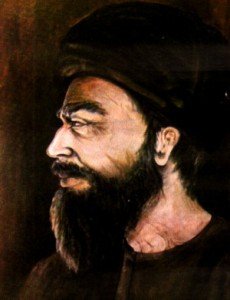
Al Tabbari (838–870)
Contrary to popular belief, Lorem Ipsum is not simply random text. It has roots in a piece of classical Latin literature from 45 BC
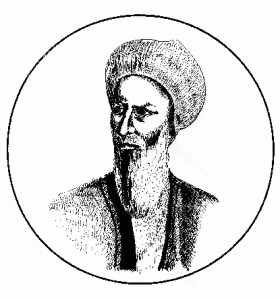
Al Razi (Rhazes) (841–926)
Contrary to popular belief, Lorem Ipsum is not simply random text. It has roots in a piece of classical Latin literature from 45 BC
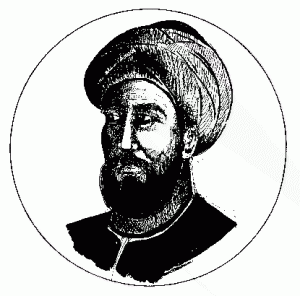
Al Zahrawi (930–1013)
Contrary to popular belief, Lorem Ipsum is not simply random text. It has roots in a piece of classical Latin literature from 45 BC
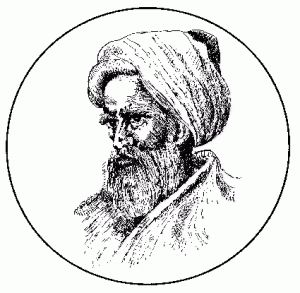
Ibn Al Haitham (960–1040))
Contrary to popular belief, Lorem Ipsum is not simply random text. It has roots in a piece of classical Latin literature from 45 BC